

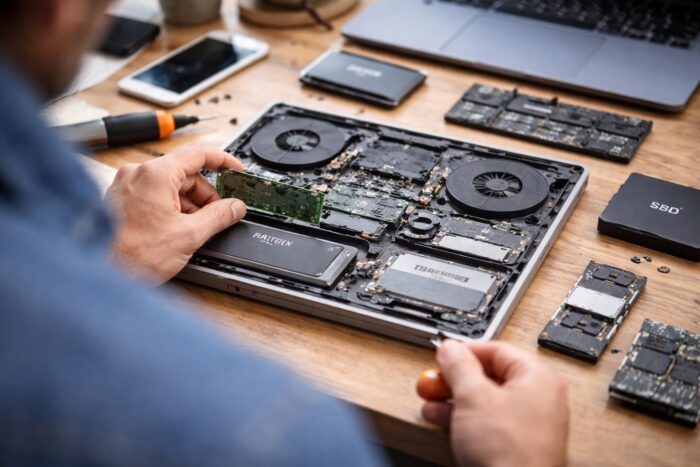
The laptop industry is witnessing a philosophical divide that could reshape how consumers buy and maintain their computers for years to come. While Apple continues perfecting its seamlessly integrated approach with soldered components and proprietary architecture, the world’s three largest PC manufacturers are moving decisively toward modular, user-upgradeable designs that prioritize repairability and longevity.
Dell, HP, and Lenovo have collectively announced initiatives throughout 2024 and early 2025 that signal a fundamental shift in laptop engineering philosophy [1]. These changes come as right-to-repair legislation gains momentum globally and consumers increasingly voice frustration with disposable electronics that become obsolete within a few years.
The Great Hardware Divergence
The contrast couldn’t be starker. Apple’s latest MacBook Pro and MacBook Air models feature unified memory architecture where RAM is integrated directly into the M-series chip package, making upgrades physically impossible [2]. Storage is soldered to logic boards, batteries are adhesive-mounted, and even simple repairs often require specialized tools and proprietary diagnostics software.
Meanwhile, Dell’s latest Latitude business laptops feature easily accessible RAM slots, replaceable SSDs, and modular batteries that snap out without tools. HP’s new EliteBook series includes what the company calls “sustainable design modules” that allow IT departments or end users to swap components in minutes rather than hours [1]. Lenovo’s ThinkPad line has expanded its tool-free upgrade options across more models, including mid-range configurations previously locked down.
This isn’t just about making repairs easier. It represents competing visions for the future of personal computing and sustainability in the technology sector.
Why PC Makers Are Embracing Modularity
Several converging factors explain this strategic pivot by traditional PC manufacturers.
Regulatory Pressure and Right-to-Repair Laws
The European Union’s regulations on device repairability have created significant pressure on hardware manufacturers [3]. New rules requiring companies to provide replacement parts and repair documentation for extended periods have made modular design not just consumer-friendly but legally advantageous. Several U.S. states have passed or are considering similar legislation.
Dell, HP, and Lenovo operate in enterprise markets where corporate IT departments demand long device lifecycles and the ability to service equipment in-house. A laptop that can have its RAM upgraded or battery replaced extends its useful life by years, reducing total cost of ownership for businesses purchasing thousands of units.
Environmental Sustainability Commitments
All three manufacturers have made public commitments to sustainability that modularity directly supports. When users can upgrade RAM from 8GB to 16GB rather than buying a new laptop, it reduces electronic waste significantly. Replaceable batteries mean devices don’t become landfill fodder when lithium cells degrade after 500 charge cycles.
HP has specifically marketed its modular designs as part of its goal to become the world’s most sustainable technology company [1]. Dell’s “Design for Environment” program explicitly incorporates repairability metrics. Lenovo has emphasized circular economy principles where components can be harvested and reused.
Competitive Differentiation
With Apple commanding premium pricing and customer loyalty through its ecosystem, PC makers need differentiation strategies. Modularity and repairability offer compelling selling points, especially to cost-conscious buyers, environmentally aware consumers, and business customers watching bottom lines.
The message is clear: choose our laptop and you’re not locked into our upgrade cycle. You control when and how you improve your device’s performance.
What Modular Design Actually Means
The implementation varies across manufacturers, but common elements include:
User-accessible RAM slots allow memory upgrades without voiding warranties. A laptop purchased with 8GB can be upgraded to 32GB as needs and budgets allow. Standard M.2 SSD slots mean storage can be replaced or upgraded using widely available components rather than proprietary drives. Some models now include dual M.2 slots for easy expansion. Replaceable batteries that either snap in and out or require minimal disassembly. Some newer designs use battery packs that slide out after loosening a single captive screw. Modular ports and expansion where USB, HDMI, and other connectivity options can be swapped or upgraded as standards evolve. This extends device relevance as new connection types emerge. Documented repair procedures with publicly available service manuals, part numbers, and diagnostic tools that third-party repair shops can access.
The Apple Counterargument
Apple hasn’t remained silent about its design philosophy. The company argues that integration delivers tangible benefits that modularity cannot match.
Performance optimization through unified memory architecture genuinely does improve speed and efficiency. When RAM sits on the same package as the processor, data transfer rates increase dramatically while power consumption drops [2]. Form factor advantages mean Apple’s laptops achieve remarkable thinness and lightness. Soldered components take less space than sockets and connectors. Every millimeter matters when designing ultraportable devices. Reliability improvements come from fewer connection points and moving parts. Socketed RAM can work loose over time; soldered memory cannot. Integrated batteries allow engineers to use every cubic millimeter of internal space efficiently. Security benefits emerge from tightly controlled hardware-software integration. Apple’s approach makes certain classes of attacks more difficult when the entire stack is designed holistically.
These aren’t illegitimate arguments. Apple’s laptops regularly win praise for build quality, performance, and user experience. The company maintains that most consumers never upgrade components anyway, making modularity a feature few people actually use.
Market Response and Consumer Sentiment
Early market data suggests consumers appreciate having options. Dell reports that business customers specifically cite upgradeability as a purchase factor, with IT departments valuing the flexibility modular designs provide [1]. HP’s sustainable design modules have resonated with corporate buyers implementing environmental initiatives.
However, the consumer market remains more complicated. Many mainstream buyers prioritize initial price, design aesthetics, and brand reputation over future upgradeability. Apple’s continued strong MacBook sales demonstrate that integration isn’t a dealbreaker for millions of customers who value the overall experience.
The enthusiast community and repair advocates have celebrated the PC makers’ direction. Organizations like iFixit have awarded higher repairability scores to recent Dell, HP, and Lenovo models, creating positive publicity and grassroots support.
Implications for the Industry
This divergence creates interesting dynamics for the laptop market moving forward.
Longer replacement cycles could become standard for modular laptops. If users can upgrade a three-year-old laptop’s RAM and storage for a few hundred dollars rather than spending over a thousand on a new device, upgrade cycles extend. This benefits consumers but potentially reduces unit sales for manufacturers. Third-party component markets will likely expand. Companies producing compatible RAM, SSDs, and batteries for popular modular laptop models represent a growing industry segment. This creates jobs and competition that can drive component prices down. Specialized markets may emerge where modularity commands premium pricing from certain buyer segments, much as mechanical keyboards and desktop PCs appeal to enthusiasts willing to pay more for flexibility. Repair shop networks gain viability when laptops can actually be repaired economically. Local businesses can service devices without manufacturers controlling the entire service channel.
What This Means for Buyers
Consumers now face a genuine choice between philosophies rather than merely between brands.
Choose Apple if you prioritize cutting-edge performance, seamless ecosystem integration, premium build quality, and don’t anticipate upgrading components. Accept that your laptop’s specifications at purchase are essentially permanent.
Choose Dell, HP, or Lenovo if you value future-proofing, want control over upgrades, prefer repairing to replacing, or need longer device lifecycles. Accept that you might sacrifice some design elegance or performance optimization.
Neither approach is objectively superior—they serve different priorities and use cases. A video editor needing maximum performance might reasonably choose an integrated MacBook Pro. An IT department managing 500 laptops across a corporation might reasonably standardize on modular ThinkPads.
Key Takeaways
The laptop industry’s philosophical split between integration and modularity reflects deeper questions about consumer electronics, sustainability, and user rights. Dell, HP, and Lenovo are betting that enough buyers value repairability, upgradeability, and longevity to differentiate their products in a market where Apple’s integrated approach has dominated premium segments.
This competition ultimately benefits consumers by presenting genuine alternatives. Some users want devices they can open and upgrade; others prefer sealed units optimized for performance and portability. The market now accommodates both preferences more clearly than ever before.
As right-to-repair legislation expands and environmental concerns grow, modularity may gain further momentum. Conversely, if integration continues delivering performance advantages, Apple’s approach may prove prescient. The next few years will reveal which philosophy resonates more powerfully with the laptop-buying public.
What’s certain is that buyers in 2025 have more informed choices than in decades past. The direction you choose depends entirely on how you plan to use and maintain your laptop over its lifetime.
—
Citations:
[1] https://www.reuters.com/technology/pc-manufacturers-embrace-modular-design-repairability-2024-11-15
[2] https://www.theverge.com/laptops/apple-macbook-unified-memory-architecture-analysis
[3] https://ec.europa.eu/commission/presscorner/detail/en/ip_2024_right_to_repair_directive